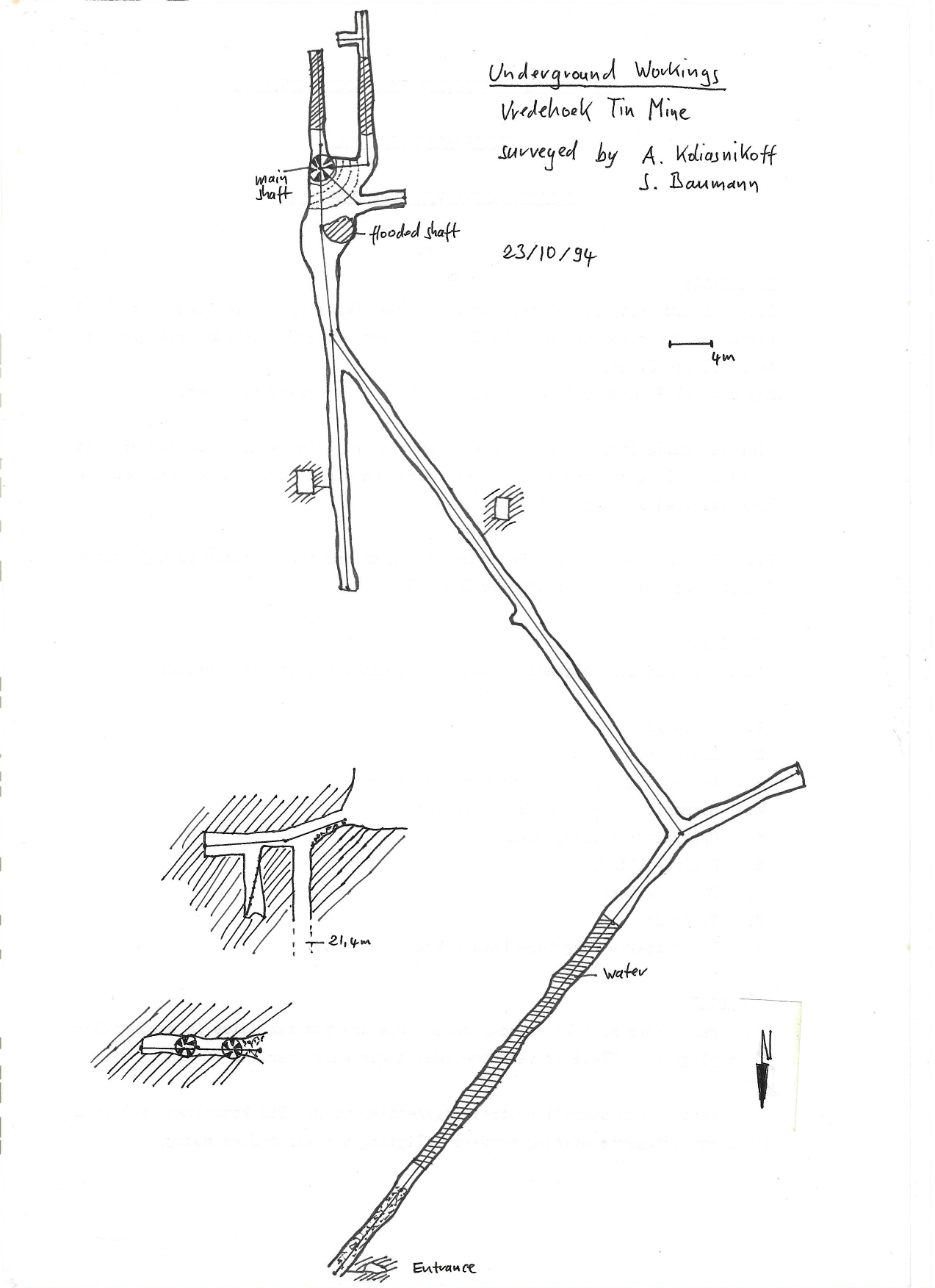
Vredehoek Tin Mine
Surveyed by A. Kdiasnikoff and S. Baumann, 23/10/1994
The interior of the mine consists of a single major horizontal adit driven into the mountain, a vertical shaft connecting the inner end of the adit with a higher point in the hill, a flooded shaft inside the mine and a number of drives off the main adit.
The main adit runs 50 metres approximately in south-westerly direction from the horizontal entrance before turning sharply to the south-east, running a further 90 metres. At this point three other side drives branch off in various directions. The main adit obviously slopes very gently from the deepest point of the mine towards the entrance of the mine. The rock through which the main adit, and indeed the entire mine, has been driven seems to be very firm and sound, almost like a cemented tunnel.
The rock the mine has been driven into is known as greywacke, which in this case forms part of the division of the Cape System known as the Malmesbury group. The predominant types of rock are a grey-blue, dark, poorly sorted impure sandstone and a dark grey shale. The greywackes vary from a few cm to some 50 cm in thickness, sometimes grading upwards from coarse to fine and showing sedimentary structures such as crossbedding, load casts, scours and slumps. Also several quartz veins are visible in a number of places. Vertical bedding planes characterize much of the rock. Thus the walls of the main adit appear remarkably smooth. Jointing is prominent and frequently regular, with occasional faulting being visible.
There is a lot of evidence of the original mining activity. The first is a number of wooden survey pegs driven into the hanging wall. Although partly rotten after some eighty years of wet conditions they are in very good condition. Each peg still has a small nail driven into it; from there a plumbline would have hung by the surveyors. The second is a number of drillholes clearly visible in most of the drives off. Furthermore the rock in these side passages shows a fine fracture pattern radiating from the remnant of drill holes. They were probably caused by the dynamite used in blasting the rock. Finally the marks of pickaxe can be seen in many places of the mine.
Water enters the mine in various places: either through dripping down the vertical shaft, perhaps a slow but continuous overflow from the flooded sub-vertical shaft or from a small spring at the end of the neighbouring drives. They produce together a little but continuous rill flowing along the main adit towards the entrance. The strength of this stream varies, occasionally interrupted by dry stretches depending on the season. As the main entrance is blocked partially by rubble this water accumulates just inside the entrance. However, it never forms a pool deeper than ankle depth and the water has clearly found an escape route from the mine at this point. The water is cool, visually clear and tastes "sweet" – as one would expect from underground water in this geological formation. The two innermost drives off are flooded to a depth of 50 cm and 30 cm, respectively. The reason for this is possibly the rubble heap underneath the vertical shaft, blocking the way.
The main vertical shaft is 21,4 m in depth and is also driven through firm, sound rock. At the upper end of, and just behind there plunges another shaft, but only 4 m in depth. Climbing down from the upper entrance through an iron gate, over a 20 degree slope one meets onto a tiny ledge, further on a cemented platform to the second shaft. The bottom is covered by charcoal and half-burnt logs; obviously this partition of the mine had served as dwelling or primitive shelter. A ladder is leant against the wall of the shaft and it is possible to reach the other side of this little drive off. Although the entrance is so near the air is very dusty. In order to explore the main shaft the author abseiled down it. The shaft itself is very plain, 2 m in diameter. The only point of interest noted was a small cubic chamber 1,8 m on a side, 2 m high by 1,7 m which is located 8 m from the bottom. The chamber was found to be empty and its purpose is unknown – unless it was the start of a further exploratory drive, later abandoned. At about half way water drips down more or less continuously, depending on the season.
At the bottom of the main vertical shaft is a substantial pile of stone, soil, rotting timber and other debris. It has either fallen down over the years or been deliberately thrown down it. Here the visitor finds himself in a large hall measuring 6 m x 6 m and 3 drives off branching almost starlike. One is hidden behind the pile of debris and peters out to the little spring mentioned previously. The second one is 22 m long and a little stream is found close to the main chamber. The third one is very short and ends blindly. The ceiling is remarkably 4 m high.
One of the most intriguing of all features of the mine is the flooded sub-vertical shaft located at almost the deepest point of the mine. The water is clear but after about 2 m the shaft is clogged. In order to get an idea of the depth and general condition, the material will, therefore, have to be removed, possibly by pumping out the water to a certain level.
As the main adit entrance and the top of the main vertical shaft are freely connected via the adit and the shaft there is always a slight breeze through the mine. Ventilation is therefore never a problem.
Eventually, reconstructing the original operations in an abandoned mine is never easy. However, from contemporary reports and the direction of the drill holes in the mine it would seem that the first phase in the development of the mine was the sinking of the vertical shaft. As it is always simpler and cheaper to tram ore out of a mine along an adit rather than to use the energy-intensive method of hoisting it up, the main adit would have been driven, emerging from the mountainside some distance below the upper entrance to the main vertical shaft. At the same time various exploratory drives from the main adit would have been blasted. On our visits to the mine we could not find any piece of ore. The reason for this may be either that the mine was meticulously exploited or real ore was never found. Finally in an effort to intersect further ore-bearing quartz veins the sub-vertical shaft would have been sunk. This presumably yielded nothing of value and at this point the mine would have been closed down.